

Published: 22.12.2025
In September 2024, the implementation of the AI-HED – Artificial Intelligence in Higher Education Teaching and Learning, project began, with ESCS-IPL as one of the promoting institutions. This European project, funded by the Erasmus+ programme, addresses one of the most significant challenges currently facing higher education: the critical, ethical and pedagogically grounded integration of Artificial Intelligence (AI) into teaching and learning.
After its first year of implementation, the project presents concrete results and relevant insights, both at European level and within the specific context of ESCS-IPL.
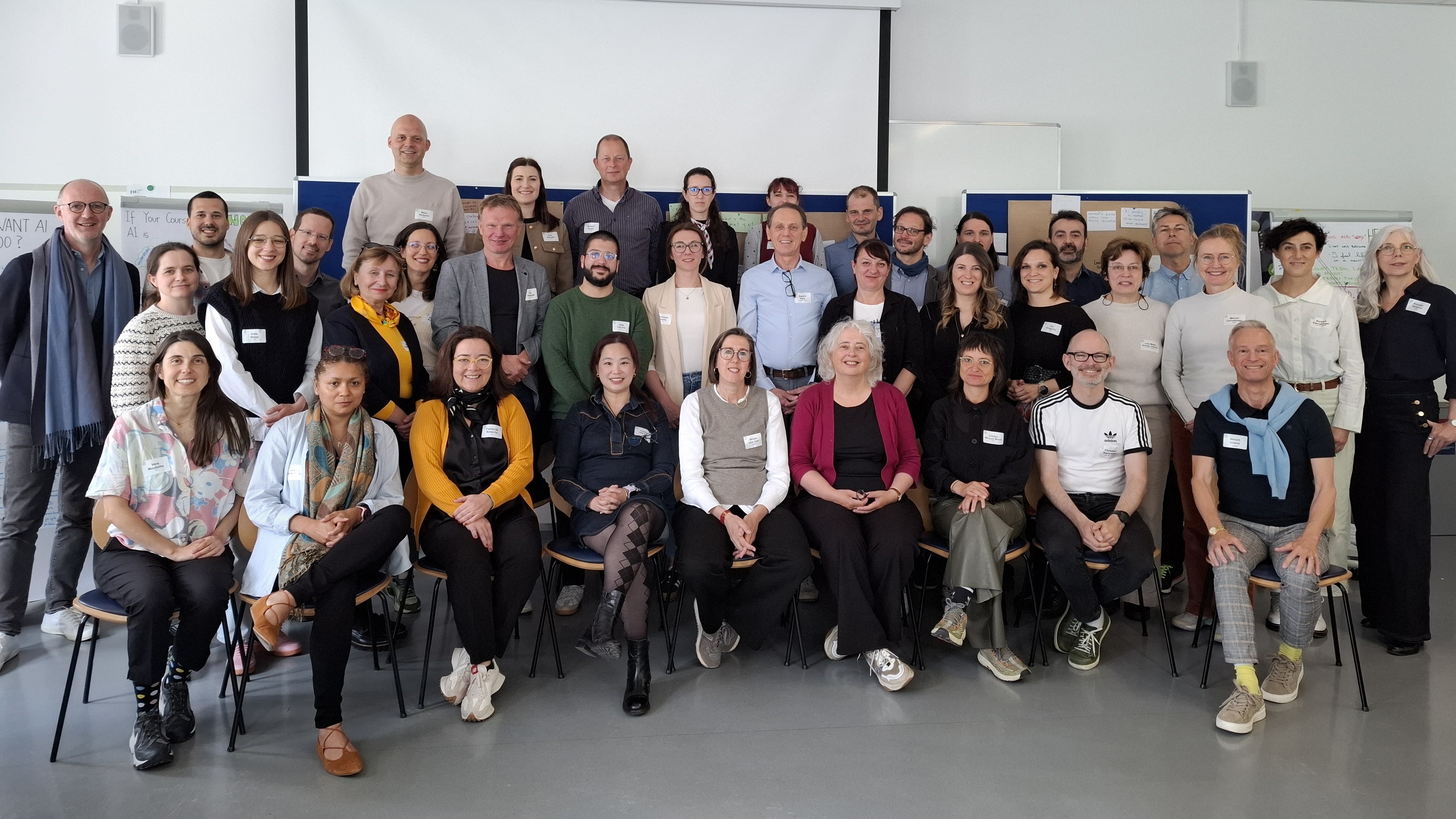
A European project with local impact
From the outset, the project was grounded in a shared observation: many lecturers felt uncertain about the rapid dissemination of AI tools, while students were already using them without clear guidance, within an institutional context still under development. Across Europe, higher education institutions were at very different stages of AI policy development, making collaboration and knowledge sharing particularly important. AI-HED thus emerged as a safe space for experimentation, reflection and joint learning.
AI-HED is coordinated by the Amsterdam University of Applied Sciences, in partnership with the University of Applied Sciences BFI Vienna, the University of Zagreb, and the Polytechnic University of Lisbon, through ESCS. Each partner contributed distinct areas of expertise — ranging from teacher training and communication to research and data analysis — which proved to be a major strength of the project.
Inclusion, accessibility and responsibility as guiding principles
From the very beginning, AI-HED has been guided by a clear principle: no one should be left behind. For this reason, one of the core pillars of the project — and particularly relevant to the mission of ESCS-IPL — is its strong commitment to inclusion. The project involves lecturers from different disciplinary areas, generations and levels of experience, while promoting gender balance and accessibility. For students, the focus is on widely available and low-cost tools, preventing AI from becoming a new source of inequality in access to education.
Concrete outcomes after the first year
Among the project’s main outcomes is the AI Starter Kit, a practical resource designed to support lecturers in understanding AI and integrating it pedagogically. Tested across all partner institutions, the Starter Kit has helped reduce anxiety around AI and increase lecturers’ confidence by prioritising concrete and applicable examples.
n 2025, the project also delivered a series of training sessions and workshops, involving around 40 lecturers across Europe and 24 courses. These collaborative moments enabled in-depth discussion of issues central to ESCS-IPL, such as ethics, assessment, academic integrity, creativity and the role of the lecturer in AI-supported learning environments.
In parallel, 24 pilot courses were designed and implemented, in which AI was integrated without altering the original learning outcomes, instead supporting the teaching process as a learning partner, feedback tool, writing aid or analytical resource.
At ESCS, during the first semester of the 2025/2026 academic year, eight pilot courses are currently being implemented, involving eight lecturers from different areas of expertise within the school.
From experimentation to pedagogical evidence
These experiences are now generating valuable data for pedagogical research. Lecturers and students complete surveys before and after the courses, and lecturers keep weekly reflective logbooks. This combination of quantitative and qualitative data makes it possible to understand how AI is being used across different disciplinary fields, levels of study (bachelor’s and master’s) and institutional contexts.
One of the most visible outcomes is a shift in attitudes: AI is gradually no longer perceived as a threat and is increasingly seen as a pedagogical opportunity when framed critically and responsibly.
Looking ahead
The project is now entering a new phase, which includes the systematisation of best practices, the development of strategic recommendations for higher education institutions, the publication of a European white paper, and the creation of an open-access MOOC on AI in teaching and learning.
For ESCS-IPL, this trajectory reinforces the school’s positioning as an institution attentive to technological transformations, committed to the ethical integration of AI, and focused on fostering critical thinking, autonomy and responsibility among its students.
Text kindly provided by Prof. PhD. Tatiana Nunes and edited by the Communication Service (Gabcom).
Photograph kindly provided by Prof. PhD. Tatiana Nunes.